Wind Turbine Subsystem Mapping, Task Matrix, and Inspection Risk Notes
Application to Utility-Scale Wind Turbines (Owner-Operated Assets)
This section applies to large, utility-scale wind turbines owned by a non-utility asset owner.
It assumes all personnel already hold required safety, GWO, and wind-specific technical certifications.
The analysis below focuses solely on whether tasks constitute regulated electrical work requiring a journeyman electrician license or registered apprentice status when performed by employees of a licensed electrical contractor.
How States Typically View Wind Turbine Electrical Systems
Wind turbines are treated as permanently installed electrical systems.
Internal turbine electrical systems are generally considered part of a fixed electrical installation once erected and commissioned.
Electrical components inside the tower, nacelle, and hub are not treated as portable equipment.
As a result, electrical licensing laws usually apply in the same manner as for industrial or generation facilities.
Typical Wind Turbine Electrical Systems
Medium-voltage generation and collection systems.
Generators and generator output conductors.
Power converters, inverters, and rectifiers.
Transformers (pad-mount, nacelle-mounted, or base-mounted).
Switchgear, switchboards, and disconnecting means.
Control wiring, protection relays, and SCADA systems.
Grounding and bonding systems.
Wind Turbine Tasks That Typically REQUIRE a Journeyman Electrician or Registered Apprentice
Installing, replacing, or modifying electrical wiring or raceways inside the tower or nacelle.
Terminating or re-terminating conductors at generators, transformers, switchgear, or disconnects.
Installing or replacing power converters, inverters, or rectifier units when hardwired.
Electrical troubleshooting involving energized systems beyond simple reset or operation.
Testing, adjusting, or repairing electrical protection devices or relays.
Modifying grounding or bonding systems.
Installing or altering medium-voltage components or cables.
Electrical commissioning activities involving wiring verification or live testing.
Wind Turbine Tasks That Typically DO NOT Require an Electrical License
Mechanical maintenance on blades, hubs, yaw systems, and pitch systems where no electrical wiring is altered.
Lubrication, torque checks, and mechanical inspections.
Replacement of mechanical components not involving electrical disconnection beyond plug-and-play connectors.
Use of operator interfaces for diagnostics without accessing wiring or electrical terminations.
Visual inspection of electrical components without removal of covers or interaction with conductors.
Firmware or software updates performed through manufacturer-approved interfaces.
Gray-Area Wind Turbine Tasks (Often Misclassified)
Replacing sensors or actuators that involve hardwired connections rather than plug connectors.
Swapping control cabinets or modules that require re-termination of conductors.
Troubleshooting that escalates from mechanical fault to electrical diagnosis.
Work inside energized enclosures even if the task is labeled 'mechanical.'
Medium-voltage testing activities conducted during maintenance outages.
Regulatory Enforcement Perspective
Inspectors typically evaluate the task performed, not the worker’s title (e.g., 'wind technician').
If the task involves electrical installation, alteration, repair, or maintenance, electrician licensing laws apply.
GWO, OEM, or wind-industry certifications do not replace state electrician licensing requirements.
Asset ownership does not exempt electrical work from individual licensure requirements.
Subsystem-to-License Mapping (Utility-Scale Turbines)
Generator
✔ License typically required for: disconnecting/terminating generator leads; insulation resistance (megger) testing tied to conductors/terminations; replacing hardwired sensors inside generator terminal box; opening/working inside energized enclosures; troubleshooting ground faults, phase imbalance, or converter interface issues beyond OEM HMI resets.
✖ Typically not required for: mechanical inspection (bearings, alignment checks), lubrication tasks, vibration monitoring, borescope inspection, cleaning/corrosion mitigation when no wiring/terminations are disturbed.
Yaw System
✔ License typically required for: replacing yaw drive motors when hardwired; re-terminating conductors at yaw motors/brakes; replacing/rewiring yaw control cabinets; troubleshooting yaw electrical faults inside panels/enclosures.
✖ Typically not required for: mechanical yaw drive maintenance (gearbox inspection, greasing, torque checks), brake pad/mechanical actuator servicing when electrical connections remain plug-and-play and no wiring is modified.
Pitch System
✔ License typically required for: wiring changes to pitch motors/actuators; replacing pitch drives or pitch control cabinets requiring conductor termination; work on pitch backup power (batteries/UPS) when it involves hardwired circuits; troubleshooting inside pitch control panels.
✖ Typically not required for: mechanical pitch bearing inspection, lubrication, bolt torqueing; replacing purely mechanical linkages; battery swap that is OEM plug-in/quick-connect without rewiring (subject to enclosure access rules).
Converter / Power Electronics (Rectifier/Inverter/IGBT Cabinets)
✔ License typically required for: replacing converter modules/cabinets where conductors must be disconnected/terminated; DC link work; busbar/termination work; verifying torque on power terminations; troubleshooting using test equipment beyond OEM guided procedures; replacing hardwired cooling fans/sensors inside cabinets.
✖ Typically not required for: filter/cooling system mechanical servicing that does not involve wiring changes (e.g., cleaning heat exchangers, replacing air filters), software/firmware updates via OEM interface.
Transformer (Nacelle, Tower-base, or Pad-mount)
✔ License typically required for: medium-voltage terminations; bushing work; tap changer work that involves electrical access; testing (TTR, Doble, insulation tests) when connecting to MV/HV conductors; grounding/bonding modifications; replacing hardwired space heaters/controls.
✖ Typically not required for: oil sampling, oil level checks, mechanical inspection of radiators/cooling surfaces where no electrical terminations are accessed.
State-Specific Nuance Where Individual Licensing Enforcement Is Often Stricter
California (CA) – Electrician Certification for C-10 Contractors
California requires that persons performing work 'as electricians' for Class C-10 electrical contractors be certified (or be registered trainees/apprentices meeting specific conditions).
Field expectation: on projects involving fixed electrical installations (including turbines and collection systems), inspectors commonly ask for proof of certification/trainee registration and supervision documentation for anyone doing electrical connections or terminations.
Primary references: California DIR Electrician Certification Program; Labor Code §108.2 (certification required for C-10 electrician work).
Sources: https://www.dir.ca.gov/dlse/ecu/ElectricalTrade.html ; https://california.public.law/codes/labor_code_section_108.2
Minnesota (MN) – 'Perform or Supervise' Electrical Work Standard
Minnesota’s statute is explicit that (with exceptions) no individual may perform or supervise electrical work unless appropriately licensed; journeyperson licensure is required for most installation/alteration/repair functions.
Wind context: turbine electrical troubleshooting, terminations, cabinet work, and technology circuits (SCADA/control) can trigger licensure (including power-limited technician licensing for certain circuits).
Primary reference: Minn. Stat. §326B.33 (individual licensure to perform/supervise electrical work).
Source: https://www.revisor.mn.gov/statutes/cite/326B.33
Colorado (CO) – Clear 'Must Have License' Language
Colorado states that no person shall engage in the trade of journeyman electrician, master electrician, or residential wireman without a license.
Wind context: re-terminations, cabinet work, and electrical maintenance inside turbines are typically treated as electrician work unless a narrow exception applies.
Primary reference: C.R.S. §12-115-109 (electrician must have license).
Source: https://colorado.public.law/statutes/crs_12-115-109
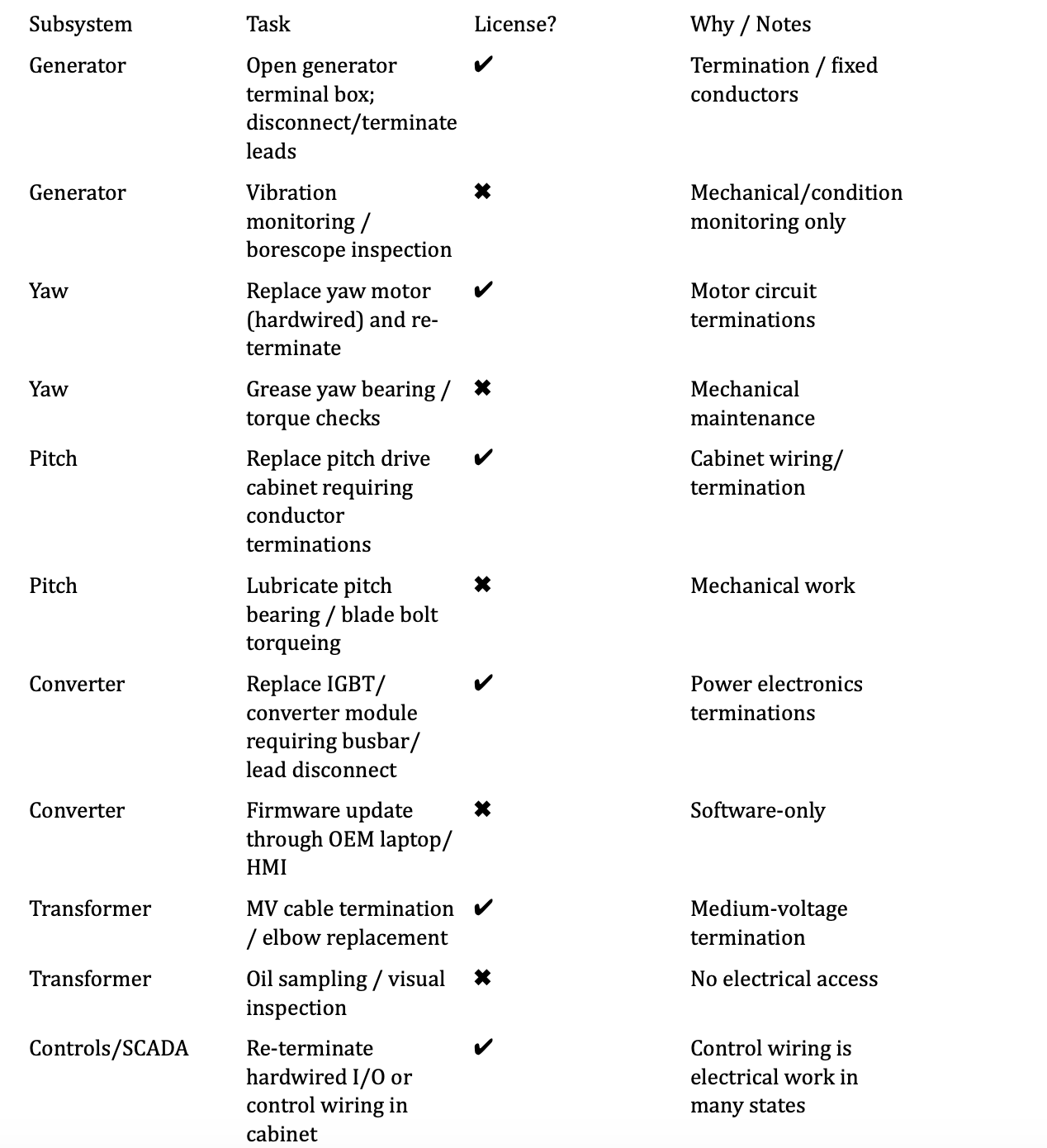
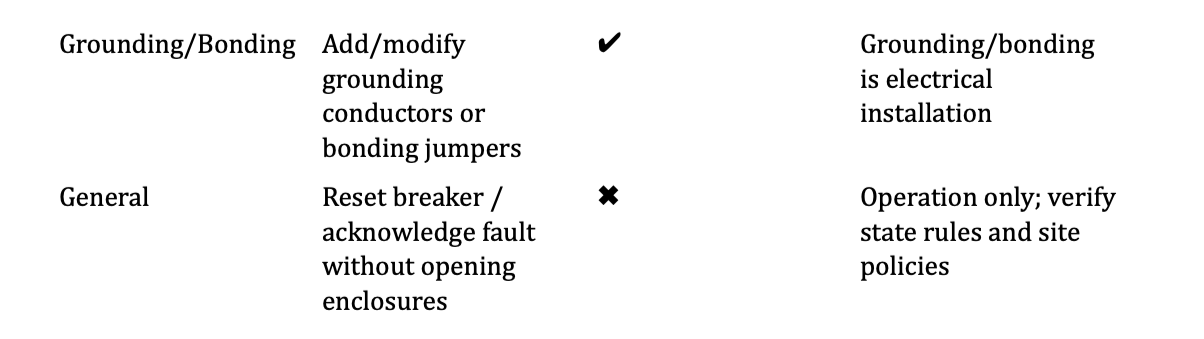
Maintenance Task Matrix (Typical Utility-Scale Turbine Work)
Legend: ✔ = typically requires journeyman electrician or registered apprentice under supervision; ✖ = typically does not require electrician license (mechanical/operations-only), assuming no wiring/terminations are altered.

Inspection-Risk Notes (How Citations and Violations Are Commonly Written)
Inspectors usually cite the underlying rule as 'unlicensed practice' or 'uncertified person performing electrical work,' and the narrative focuses on the observable act: 'made terminations,' 'installed wiring,' 'worked in panel/cabinet,' or 'performed electrical troubleshooting.'
Common trigger phrases in citation narratives include: 'install/alter/repair,' 'connect/disconnect conductors,' 'opened energized enclosure,' 'performed wiring modifications,' 'terminated controls wiring,' or 'worked without required certification/registration.'
Documentation gaps drive risk: inability to produce on-site proof of journeyman license/certification, apprentice/trainee registration, or supervision/ratio records (where applicable).
‘Wind technician’ titles and GWO/OEM training generally do not mitigate licensing findings if the task is electrical in nature.
Gray-area work is where enforcement happens most: sensors, actuators, cabinet swaps, and control wiring changes—especially when the work order is written as 'mechanical' but requires conductor termination.
Best practice: write work orders and job hazard analyses with task-level clarity (e.g., 'replace yaw motor and re-terminate conductors' vs. 'yaw service') and ensure the worker’s credential matches the task.